General Information
One Harrison Plaza
Florence, AL 35632
(256) 765-4100
1.800.TALK.UNA

History
- Established in 1830
- Alabama’s oldest public 4-year university
Location
- Beautiful 130-acre campus in historic Florence, Alabama—within walking distance of downtown restaurants, shops, and businesses
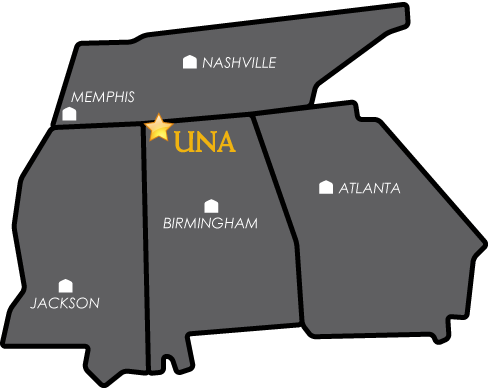
- UNA is located within a four-city area on the banks of the Tennessee River known as the Shoals: Florence, Tuscumbia, Muscle Shoals, and Sheffield
- The Shoals is steeped in arts, culture, and entertainment—and is home to the famous Muscle Shoals sound
Live Lion Mascots
- UNA is home to Leo III
- The lion is housed in a state-of-the-art secure habitat on campus, next door to the President's home
Students
- More than 9,500 students enrolled
- 63 % women, 37 % men
Learn more about student life on campus
Tuition, Scholarships and Financial Aid
- Tuition is among the lowest in the state
- Roughly 1/3 of UNA students receive an institutional or endowed scholarship from the University
More Financial Aid and Scholarship Information
Delores and Weldon Cole Honors College
- Home to more than 700 students for fall 2022
- Benefits include small classes, tuition and scholarships, job/internship placement, peer mentoring, 24-hour access to the Honors Center, and many extracurricular opportunities.
- More than 98% of Cole Honors College graduates are employed in their degree fields or pursuing graduate degree work
More information on the Cole Honors College
International Studies
- A diverse population includes international students from 69 countries
- UNA offers a wide variety of study abroad programs including those in Costa Rica, Africa, France, Australia and China, among many others
More Information on International Studies
Majors and Concentrations
- More than 300 degreed programs & concentrations
In the Classroom
- 67% of classes are taught by full-time faculty
- Average class size is 24 students
- 18:1 student-to-faculty ratio
Alumni
- More than 70,000 alumni throughout the world
Notable alumni from the University of North Alabama
Athletics
- UNA operates 14 renowned collegiate athletic programs in NCAA Division I's ASUN Conference
- UNA teams have collected more than 40 conference championships, dozens of No. 1 national rankings and seven national titles—ROAR LIONS!
More Information on UNA Athletics
Economic Impact
- 2022 - UNA’s Economic Impact to Shoals More than $340 Million Annually
- 2017 - More than $316 million in direct and indirect spending related to the local economy
Accreditations
- The University of North Alabama is accredited by the Southern Association of Colleges and Schools Commission on Colleges (SACSCOC) to award baccalaureate, masters, and doctorate level degrees. Questions about the accreditation of the University of North Alabama may be directed in writing to the Southern Association of Colleges and Schools Commission on Colleges at 1866 Southern Lane, Decatur, GA 30033-4097, by calling (404) 679-4500, or by using information available on SACSCOC’s website (www.sacscoc.org).
- Able to award bachelor’s, master’s and education specialist degrees