Melissa Moore, PhD
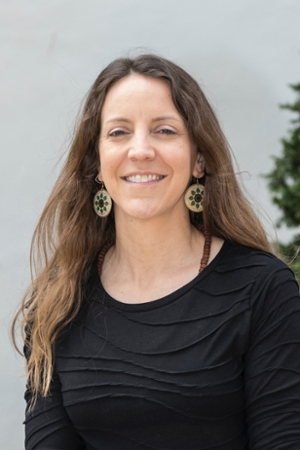
Professor
Education
- Ph.D. Geophysics, University of Memphis, Center for Earthquake Research and Information
- M.S. Geophysics, Arizona State University, School of Earth and Space Exploration
- B.S. Geology, University of North Alabama, Department of Geology
Areas of Expertise
- Subduction Zone Dynamics & Seismic Tomography
- Core-Mantle Boundary Anisotropy & Processes
- Waveform Cross-correlation & Seismic Processing
- Tectonics
- Energy Resources
- Costa Rica, Alaska, Iceland
About
Melissa Moore is a Professor in the Department of Physics & Earth Science. Melissa is a seismologist, and her research focuses on using seismic waves to determine the structure of subduction zones to better understand seismogenic processes and dynamics. She is currently Co-PI on a research project in southern Alaska (SALMON: Southern Alaska Lithosphere and Mantle Observatory Network), an EarthScope Flexible Array experiment. The science objective of SALMON is to use local and teleseismic earthquakes to image the seismic structure of the crust and upper mantle to better understand the active tectonic setting and the tectonic history of the Cook Inlet region. Past research includes seismic anisotropy of the Core-Mantle Boundary and seismogenic zone structure of the Nicaraguan and Costa Rican subductions zones using local earthquake tomography.
Melissa is also the PI of the National Science Foundation (NSF) S-STEM program at UNA, providing scholarship to STEM majors from rural Alabama high schools.
Melissa received her BS in geology at the University of North Alabama and her MS in geophysics from Arizona State University. She earned her PhD in geophysics from the Center for Earthquake Research and Information (CERI) at the University of Memphis.
Courses
- ES 131 Physical Geology
- ES 131H Honors Physical Geology
- ES 133 Earth Systems
- ES 302 Energy
- ES 348 Earth Resources
- ES 350 Introduction to Geophysics
- ES 365 Data Analysis in Geophysics
- ES 410 Tectonics
- ES 420 Seismology
- ES 431 Structural Geology
Selected Publications
Moore, M.M., H. DeShon, R. Harris, and W. Rabbel, in revision, 2023. 3D Double Difference Velocity Tomography of Costa Rica and Nicaragua, Geosphere: Subduction Top to Bottom 2.
Nayak, A., Eberhart-Phillips, D., Ruppert, N., Fang, H., Moore, M.M., Tape, C., Christensen, D., Abers, A., Thurber, C., 2020. Three-Dimensional Seismic Velocity Models for Alaska from Joint Tomographic Inversion of Body-Wave and Surface-Wave, Seismo. Res. Lett., vol. 91, no. 6., pp. 3106-3119, doi: 10.1785/0220200214.
Buckley, G. and M.M. Moore-Driskell, 2019. Challenges in Teaching Climate Science Literacy in Alabama, Part I: Climate Change and the Southeast U.S. Warming Hole, Journal of Sustainability Studies, vol 1, iss. 2.
Tape, C., D. Christensen, M.M. Moore-Driskell, J. Sweet, K. Smith, 2017. Southern Alaska Lithosphere and Mantle Observation Network (SALMON): a seismic experiment covering the active arc by road, boat, plane, and helicopter, Seismo. Res. Lett., vol. 88, no. 4, doi:10.1785/0220160229.
Tape, C., D. Christensen, M.M. Moore-Driskell, 2015. Southern Alaska Lithosphere and Mantle Observation Network, International Federation of Digital Seismograph Networks. Seismic Network, doi: 10.7914/SN/ZE_2015.
Kyriakopoulos, C., A.V. Newman, A.M. Thomas, M.M. Moore-Driskell, G.T. Farmer, 2015. A new seismically constrained interface model for Central America, J. Geophys. Res. Solid Earth, 120 doi:10.1002/2014JB011859.
Hansen, S.E., H.R. DeShon, M.M. Moore-Driskell, and A.M.S. Al-Amri, 2013. Investigating the P wave velocity structure beneath Harrat Lunayyir, northwestern Saudi Arabia, using double-difference tomography and earthquakes from the 2009 seismic swarm, J. Geophys. Res. Solid Earth, vol. 118, doi:10.1002/jgrb.50286.
Moore-Driskell, M.M., H. DeShon, W. Rabbel, M. Thorwart, Y. Dzierma, and I. Arroyo, 2013. Integration of Arrival Time Datasets for Consistent Tomography Quality Control: A Case Study of Amphibious Experiments Along the Middle America Trench, Bull. of Seismo. Soc. of Am., vol. 103, no. 5, doi:10.1785/0120120274.
Moore, M.M., E. J. Garnero, T. Lay, and Q. Williams, 2004. Shear wave splitting and waveform complexity for lowermost mantle structures with low-velocity lamellae and transverse isotropy, J. Geophys. Res., 109, doi:10.1029/2003JB002546.
Garnero, E.J., M.M. Moore, T. Lay and M. Fouch, 2004. Isotropy or weak vertical transverse isotropy in D" beneath the Atlantic Ocean, J. Geophys. Res., 109, doi:10.1029/2004JB003004.
Selected Research Grant Proposals
Alexander, R., M.M. Moore, A. Paulk, M. Mathis, preparation 2020-2022. Tennessee Valley Tri-State LSAMP - STEM Pathways Implementation, National Science Foundation: Louis Stokes Alliances for Minority Participation (LSAMP)- NSF 17-579). ~$2,000,000.
Moore-Driskell, M.M. and D. Mencin, in preparation 2023. Constraints on Subduction in Northwest Colombia, National Science Foundation, Division of Earth Sciences: Geophysics.
Alexander, R., M.M. Moore-Driskell, A. Paulk, T. Blackstone, M. Mathis, 2020. Tennessee Valley Tri-State LSAMP Pre-Alliance Planning, National Science Foundation: Louis Stokes Alliances for Minority Participation (LSAMP)- NSF 17-579). $125,000, FUNDED.
Moore-Driskell, M.M. (PI), A. Paulk, and C. Burkhalter, FY2020-FY2024, Award No. 1929409. Creating STEM Opportunities for High-Achieving Rural Alabama Students, National Science Foundation Scholarships in Science, Technology, Engineering, & Mathematics (S-STEM) – 17-527, $647,613, FUNDED.