Fall 2025 Newsletter
Growing Together: UNA, USDA, and IFDC Unite for Innovation
By Dr. Eric Becraft, Associate Professor of Biology
Global agriculture faces many challenges in trying to get improved crop yields for food security in countries all around the globe. Fertilizer companies have been experimenting for decades to determine the best way to deliver primary nutrients such as nitrogen, sulfur, and phosphorus in different soil types while also mitigating negative environmental effects. Microorganisms have long been known to increase nutrient uptake and improve overall plant health, though it can be difficult to examine soil communities because there are an estimated one-hundred billion bacteria per gram of soil. Understanding the role of soil microbiome (defined as the total bacterial community that contributes to the ecosystem) in relation to nutrient uptake and total crop yield could be the next frontier of fertilizer development.
Organo-fertilizers are an optimistic alternative to traditional chemical fertilizers to increase soil nutrient uptake and minimize agricultural run-off. The goal of organo-fertilizers would be to deliver lower concentrations of primary nutrients while providing organic nutrients for microbes that enhance the growth of the crop and ultimately provide for primary nutrients. To analyze the impact of organo-fertilizers on the soil microbiome, UNA is collaborating with the International Fertilizer Development Center (IFDC) to analyze changes in microbial diversity in response to different organo-fertilizer treatments. UNA also is collaborating with the USDA (United States Department of Agriculture) to analyze the presence of antibiotic resistance genes in organo-fertilizer treated soils, which could indicate the presence to pathogens or other antibiotic resistant bacteria.
The initial experiment consisted of wheat plants treated with organo-fertilizers, which were sampled after 30 days of growth (Figure 1). Total DNA was extracted from the soil samples and marker genes were sequenced to observe the changes in the soil microbiome. Microbial abundance and biodiversity significantly increased in all organo-fertilizer samples compared to unfertilized soil or chemical fertilizer samples. The prominent bacterial populations that were identified shifted from primarily organic carbon degraders, to populations that are more involved in nitrogen and sulfur cycling, including the critical metabolic process of nitrogen fixation. Additionally, some organo-fertilizers were identified that consistently contained antibiotic resistance genes, indicating a fertilizer type that could be potentially avoided for use in food crops.
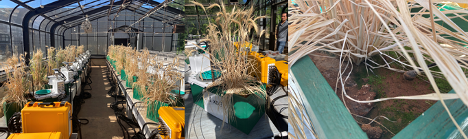
Figure 1 (left to right). Greenhouse at IFDC growing wheat plants over 30-day period. Individual wheat plants and soil sampled after different fertilizer treatments.
Results showing significant increases in microbial abundance and biodiversity in organo-fertilizer soils compared to unfertilized soil and chemical fertilizers, and the increase in critical nitrogen and sulfur cycling bacteria in those samples, are very encouraging. Future experiments are being planned to target different soil types and crops. These experiments represent an exciting collaboration between UNA, the USDA, and the IFDC, an international nonprofit housed locally in Muscle Shoals, AL, which could lead to higher crop yields and healthier soils with less negative environmental impacts globally. Students at UNA get firsthand experience in molecular laboratory techniques and bioinformatic methods analyzing microbial genetic data in a critically important area for agriculture and human health. The antibiotic resistance in organo-fertilizer results have benefited the scientific community in the form of a published manuscript in the methods journal Nature Protocols, with a UNA student (Glauco Teixeira) as the first author. The preliminary soil microbiome results have been presented as a poster at the Association of Southeastern Biologists regional conference and at local UNA events (Brianna Tran). These analyses could potentially lead to future collaborative grants focusing on the soil microbiome, or integrating these types of analyses into the larger organo-fertilizer optimization pipelines, which could lead to new impact methodologies and more opportunities for UNA student research and community outreach.
Publication on antibiotic resistance of microbes in organo-fertilizers can be found here.

Dr. Eric Becraft